Flap Surgery in Dhanbad
Some wounds need more than closure. They need reconstruction.When an injury exposes bone or tendons, simply covering the wound may not be enough. Flap surgery in Dhanbad offers a way to bring healthy, living tissue to areas that need reliable coverage and protection.
“
Sometimes the challenge is not simply closing a wound. It is bringing the right tissue, with a reliable blood supply, to the place that needs it.
”
— Dr Gaurav Patodia
Flap selection depends on the wound, any exposed structures, circulation and the tissue needed for protection or movement.
In addition, your overall health, functional needs and the effects on the donor site guide the reconstruction plan.
Why do some wounds need more than a skin graft?
A skin graft needs a wound bed that can nourish it. However, some deeper defects need living tissue with a reliable blood supply instead.
For example, your surgeon may consider flap reconstruction for:
- Exposed bone without adequate covering tissue, or tendon without a suitable nourishing surface.
- Critical structures that need durable protection, or a cavity beneath the wound known as dead space.
- Poorly vascularized tissue that cannot reliably support a graft.
Exposed tendon or bone does not automatically mean a flap is necessary. Instead, your surgeon assesses its covering tissue, wound preparation and available alternatives.
It's not just about covering the wound.
Protect important structures
Provide suitable cover over vulnerable tissues.
Provide durable coverage
Choose tissue suited to the stresses at the wound site.
Support movement
Consider tendon glide, joint position and functional needs.
Help selected complex wounds heal
Combine reconstruction with treatment of underlying problems.
Restore contour where feasible
Balance tissue volume with the needs of the defect.
Facilitate rehabilitation
Plan protection, movement and therapy around healing.
These are treatment aims, not guarantees. Because circulation and health factors affect healing, movement, limb preservation and appearance can vary.
LIVING TISSUE, PLANNED COVERAGE
Understanding Flap Reconstruction
How tissue and blood supply work together
Flap surgery moves living tissue from a donor site to a defect. Depending on the need, a flap may contain skin, fat, fascia, muscle or bone. Therefore, the surgeon selects tissue that matches the reconstruction needed.
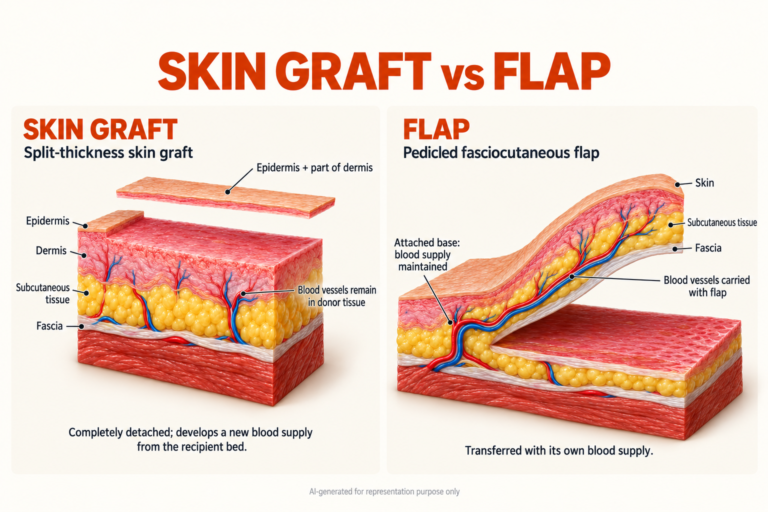
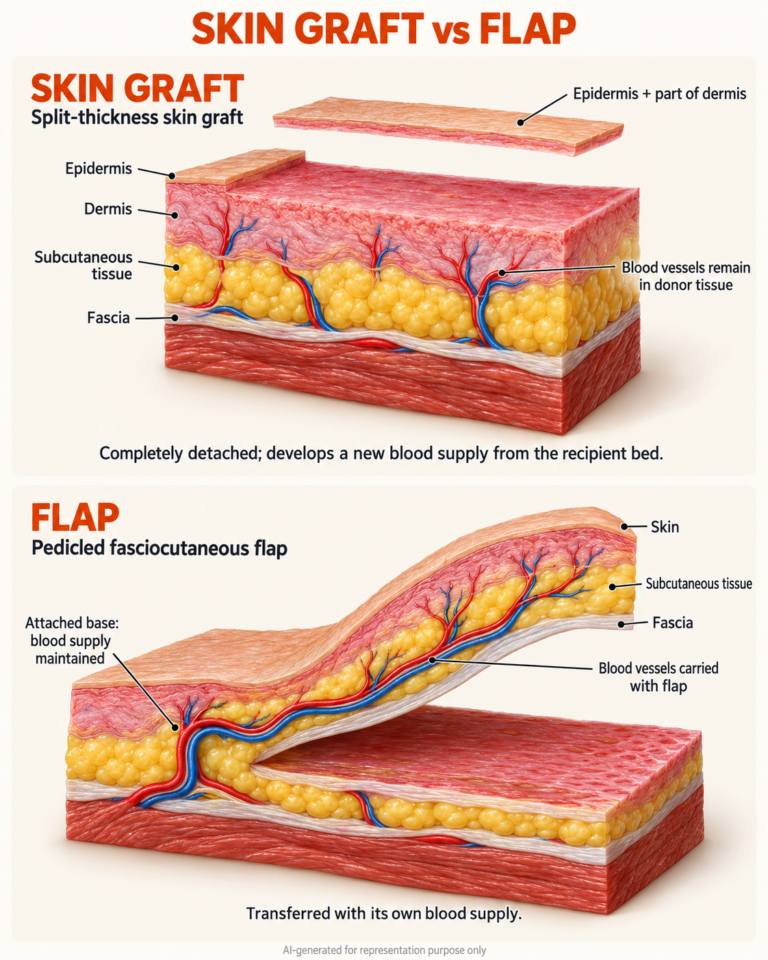
Unlike a skin graft, a flap travels with its blood vessels. It either keeps its vascular attachment or the surgeon reconnects its vessels at the recipient site. As a result, tissue thickness, durability and blood supply guide the choice.
Local flaps move nearby tissue into a defect. By comparison, regional or pedicled flaps bring tissue from a nearby region while keeping a vascular connection. Where appropriate, perforator flaps use small vessels passing through or between deeper tissues to supply skin and fat. This approach can sometimes limit muscle sacrifice.
Free-tissue transfer moves tissue completely away from its donor site. During free flap surgery, the surgeon uses microsurgery to connect its small artery and veins to vessels near the defect. However, the wound, available vessels and overall health must support this approach.
When might flap reconstruction be considered?
- Traumatic wounds of the hand, arm, leg or foot.
- Selected defects with exposed tendons, joints, implants or bone.
- Selected diabetic foot or chronic wounds, after assessing infection and vascular supply.
- Defects following tumour removal.
- Selected burns and post-burn reconstruction.
- Pressure-related wounds in appropriately selected patients, alongside pressure relief and ongoing care.
The right reconstruction begins with the right plan.
Assessment begins with the wound's size, depth and location, the exposed structures and the function the area needs to support.
Next, the surgeon evaluates blood supply and infection. Before definitive soft-tissue reconstruction, the team may remove unhealthy tissue and treat infection.
The simplest suitable reconstruction is often the best starting point.
In addition, flap choice balances the coverage needed with circulation, tissue quality and the effects of taking tissue from the donor site.
Depending on the wound, some patients need vascular imaging, other investigations or additional procedures. Therefore, surgery may involve one or more stages.
After surgery, monitoring, wound care, pressure relief and an individual rehabilitation plan help protect the reconstruction.
Different routes to wound coverage
Local flap: nearby tissue moves into the defect while maintaining a blood supply.
Pedicled flap: tissue moves with its vascular attachment preserved.
Free flap: tissue transfers to a new site, where microsurgical connections restore its circulation.
Frequently Asked Questions
What is the difference between a skin graft and a flap?
A skin graft transfers skin without its own blood supply. It must establish nourishment and new circulation from the recipient bed.
A flap moves with its blood vessels. It either retains a vascular attachment or regains circulation through microsurgical vessel connections.
Does every complex wound need microsurgical flap surgery?
No. For example, the surgeon can reconstruct some defects with simpler local or regional flaps, or with other suitable methods.
However, the surgeon may consider a microsurgical free flap when necessary and suitable. Wound requirements, available vessels, donor-site options and overall health guide that decision.
How long does recovery take after flap surgery?
Recovery depends on the wound, the operation, circulation, donor-site healing and any other health conditions.
Because recovery needs vary, dressings, monitoring, activity restrictions and rehabilitation also differ. Your surgeon will discuss an individual plan and adjust it as healing progresses.
YOUR NEXT STEP
A complex wound deserves an individualised reconstruction plan.
If you are considering flap surgery in Dhanbad, arrange a consultation with Dr Gaurav Patodia. You can discuss your wound, feasible reconstructive options and their limitations. Together, you can clarify the next steps in wound coverage and rehabilitation.
Dr Gaurav Patodia
Plastic, Reconstructive & Cosmetic Surgeon
Dhanbad
Call: 8789793236
Discuss Reconstruction on WhatsApp