SKIN GRAFTING
When a wound cannot close on its own, reconstruction may help it move forward.
Plastic & Reconstructive Surgery | Dhanbad
Skin grafting in Dhanbad with Dr Gaurav Patodia.
“
A skin graft is not simply about covering a wound. The real decision is whether the wound beneath it is ready to support new skin.
”
— Dr Gaurav Patodia
Before planning a graft, I assess the wound's depth, blood supply, underlying structures and possible causes of delayed healing.
Sometimes a skin graft is appropriate. Sometimes preparing the wound—or choosing another method of reconstruction—is more important.
WHY DO SOME WOUNDS REFUSE TO CLOSE, EVEN AFTER WEEKS OF DRESSING?
A wound may look clean but still need more than dressings to achieve closure.
Three things can make the difference:
- Whether enough healthy tissue remains to support healing.
- Whether the wound has a suitable blood supply.
- Whether skin grafting is actually the right reconstruction for that location.
The important question isn't only how large the wound is. It's what lies underneath it.
Can skin from another part of your body help close the wound?
Skin grafting is a reconstructive procedure in which healthy skin is taken from one part of your body and transferred to an area where skin has been lost.
It may be considered for wounds caused by burns, injuries, surgical removal of diseased tissue or selected non-healing ulcers.
But not every open wound can accept a skin graft.
A graft relies on the underlying wound bed to develop the blood supply needed for survival.
If the wound is infected, poorly vascularized or contains unsuitable exposed structures, additional preparation or a different reconstruction may be required.
A skin graft closes a suitable wound. It cannot correct every problem responsible for keeping that wound open.
Not all skin grafts are the same.
Split-thickness skin grafting (SSG/STSG) transfers the outer layer of skin with part of the dermis. It is commonly used for larger suitable wounds, including those following trauma and burns.
Full-thickness skin grafting (FTSG) transfers the epidermis and full dermis. It may be selected for smaller defects where skin quality, contraction and appearance are particularly relevant.
The choice depends on the wound, its location and the reconstructive requirements.
CLINICAL OVERVIEW
Skin Grafting Surgery in Dhanbad
Skin grafting in Dhanbad: planning your treatment
Dr Gaurav Patodia provides assessment and reconstructive surgical treatment for skin loss, burns, traumatic wounds and selected non-healing wounds in Dhanbad, Jharkhand.
Skin graft surgery may be used when a wound is too large to close directly or when sufficient skin has been lost to prevent straightforward healing.
Depending on the condition, reconstruction may involve split-thickness skin grafting, full-thickness skin grafting or other wound coverage procedures.
The treatment plan considers the wound's cause, depth, circulation, infection status, location and functional needs.
The aim is to achieve appropriate wound coverage while considering durability, movement, scarring and the care required during recovery.
WHAT CAN SKIN GRAFTING HELP ACHIEVE?
Provides skin coverage — Replaces missing skin over a suitable wound surface.
Supports wound closure — May help a wound close when dressings or direct suturing alone are insufficient.
Useful after burns or injuries — Can reconstruct selected areas of skin loss after trauma or surgery.
May reduce prolonged wound exposure — Helps establish coverage when the wound bed is adequately prepared.
Supports rehabilitation — Wound closure may allow progression toward movement, therapy and recovery when clinically appropriate.
Offers different reconstructive options — Graft thickness and donor site can be selected according to wound requirements.
Results depend on wound conditions, graft survival, patient health, site and postoperative care. Scarring, colour differences, contraction and partial or complete graft failure are possible.
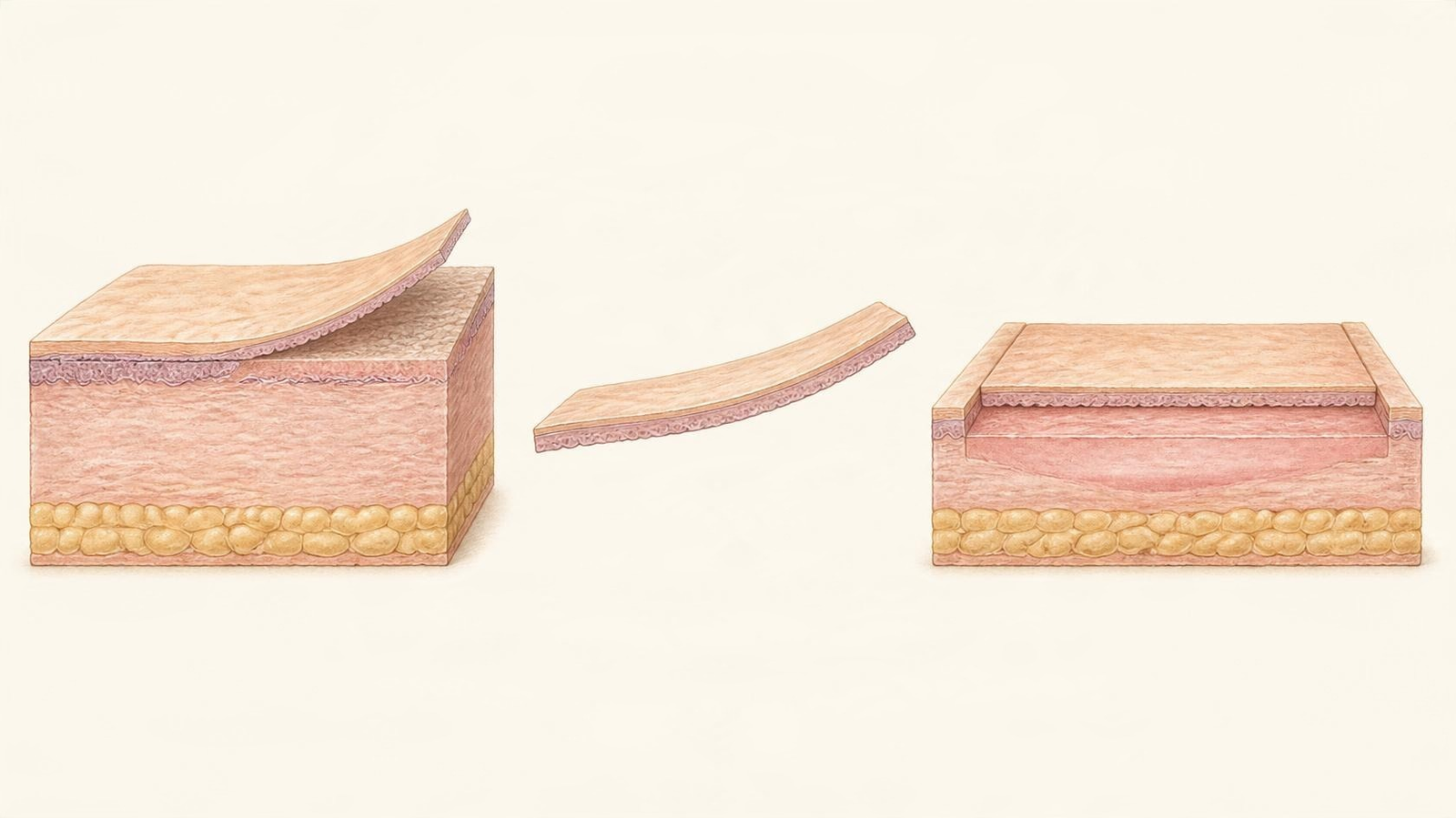
Understanding the grafting process
1. The donor site, where skin is harvested.
2. The prepared recipient wound.
3. Placement of the graft onto the wound.
Frequently Asked Questions About Skin Grafting
Is skin grafting suitable for every open wound?
No. A skin graft needs a suitable, well-vascularized wound bed.
Active infection, poor circulation or exposed structures without adequate vascular tissue may prevent successful grafting. Some wounds need preparation, alternative closure methods or flap reconstruction.
Will the skin graft look and feel like normal skin?
Grafted skin may differ from surrounding skin in colour, texture, thickness, sensation and scarring.
The degree of contraction and appearance also depends on the graft type and site. The primary goal is appropriate wound coverage, with functional and aesthetic considerations guiding planning.
How long does a skin graft take to heal?
Healing varies with graft thickness, wound location, circulation and other health factors.
The graft needs protection during its early attachment and revascularization, and the donor site also requires care. Dressings, follow-up examinations, movement restrictions and later scar management are individualized.
YOUR NEXT STEP
Your wound deserves more than another dressing without a clear plan.
If a wound has remained open, or you've been advised that skin grafting may be necessary, a reconstructive assessment can help determine what is preventing closure and which treatment options may be suitable.
Dr Gaurav Patodia
Plastic, Reconstructive & Cosmetic Surgeon
Dermacure Clinics, Bank More, Dhanbad
Call: 8789793236
Book a Wound & Reconstruction Consultation